The Department of Computer Science & Engineering (Cyber Security) was established in the year 2023 with an annual intake of 60 in the undergraduate program level.Here we empower the next generation of cyber security experts and Engineers. Our department is dedicated to advancing knowledge and innovation in the field of cyber security, addressing the growing challenges of protecting digital information and systems.In today’s digital age, the demand for cybersecurity professionals is at an all-time high. Our department is committed to providing a comprehensive education that combines the core principles of computer science with specialized training in cybersecurity. Our curriculum is designed to equip students with the skills and knowledge required to safeguard critical infrastructure, protect sensitive data, and counteract cyber threats.
Scope of Employment
The graduates get a good placement opportunity in IT firms and corporates with designations like Software Engineer, System Analyst, Network Administrator, Information System Manager, Cyber–Security Analyst, Penetration Tester, Threat Analysts, Security Software Specialist, Cyber Threat Responder and many more in various leading software companies like Deloitte, D.E.Shaw, TCS, Prodapt, Wipro, CTS, Infosys, Hexaware and Accenture.
Join Us
If you are passionate about technology and committed to protecting the digital world, the Department of Computer Science & Engineering (Cyber Security) is the place for you. Explore the endless possibilities in the field of cybersecurity and become a part of a community dedicated to making the digital world safer.
Welcome to the department of Computer Science and Engineering (Cybersecurity) at Jyothi Engineering College, Thrissur! As you glance through the faculty profile, I am sure that you will appreciate that we are fortunate to have an experienced and well qualified team. They are a vibrant group, who understand the importance of knowledge, skill and attitude in an outcome-based education system. Through innovative teaching methodology, we strive to bring out the best in every student. The B.Tech. Computer Science and Engineering with Specialization in Cyber Security programme aims to offer the students an opportunity to expand their skills in computer science and Cyber Security by offering various programming courses based on industry requirements, and core courses like data structures, database systems, operating systems, computer networks, programming in cybersecurity, cryptography and network security.
This programme will ensure in bringing radical changes in the field of Digital Forensics, Cyber Intelligence and Malware Forensics with a vision to inspire today’s brightest researchers to make a major impact in cyber world by generating innovative ideas and pursuing their research to become pioneers in the field of cyber security and also take initiative to build knowledge capacity & skill development for the community of academic, government and law enforcement. In addition, specializations courses in Cyber Security such as malware analysis, digital forensics, AI in cyber security, cybercrime and incident response, system security, blockchain, cyber threat intelligence are also offered to meet the market demands.The competency gap together with a strong need to build skill sets to meet the growing demand in various aspects of cybercrime management has been a primary trigger in starting the new course in Cyber Security.
Best regards,
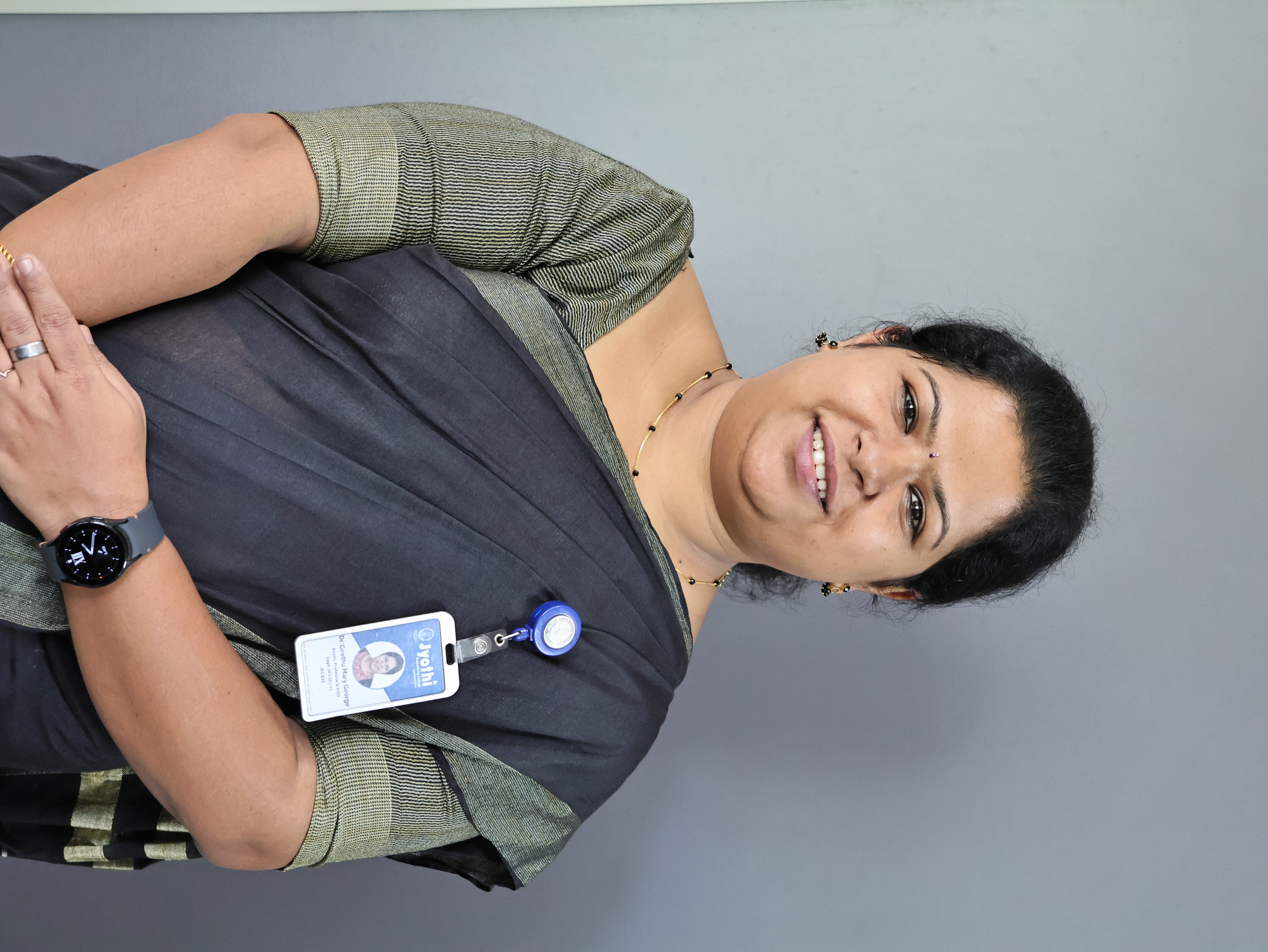
Dr. Geethu Mary George
HoD
Department of Computer Science & Engineering(Cyber Security)
Jyothi Engineering College
To be a globally recognized centre of excellence in Cyber Security education, research and innovation by nurturing ethical professionals , fostering technological advancement through responsible practice and contributing to a secure and sustainable digital society.
M1: Excellence in Education - To provide outcome-based and industry-oriented education by integrating core computer science principles with advanced cybersecurity technologies and practices. M2: Ethics and Professional Responsibility - To cultivate ethical values, integrity, social responsibility, and secure computing practices for protecting digital assets and strengthening cyber trust.
M3: Research, Innovation, and Entrepreneurship - To promote research, innovation, and entrepreneurial thinking for developing sustainable solutions to emerging cybersecurity challenges. M4: Holistic and Global Development - To enhance leadership, teamwork, lifelong learning, and global competence through industry collaboration, interdisciplinary activities, and community engagement.
Graduates will apply strong foundations in computer science and cybersecurity to design, develop, and manage secure and reliable computing systems for industry and society.
Graduates will pursue successful careers as professionals, innovators or entrepreneurs engaged in technology development, deployment or engineering system implementation in industry and society and contribute to the economic growth of the country.
Graduates will demonstrate ethical responsibility, leadership, teamwork, and effective communication while adapting to evolving global technological environments through lifelong learning.
PSO 1: Apply cyber security principles to mitigate cyber risk and analyze security requirements of an organization.
PSO 2: Develop and deploy secure software and infrastructure using modern tools and industry standards.
PSO 3: Uphold ethical, legal, and societal responsibilities while protecting privacy, data, and digital assets.
Students in the programme at the time of their graduation are expected to possess the following capabilities:
PO1 – Engineering Knowledge: Apply knowledge of mathematics, natural science, computing, engineering fundamentals and an engineering specialization to develop the solution of complex engineering problems.
PO2 – Problem Analysis: Identify, formulate, review research literature and analyze complex engineering problems reaching substantiated conclusions with consideration for sustainable development.
PO3 – Design/Development of Solutions: Design creative solutions for complex engineering problems and design/develop systems/components/processes to meet identified needs with consideration for public health and safety, whole-life cost, net zero carbon, culture, society and environment as required.
PO4 – Conduct Investigations of Complex Problems: Conduct investigations of complex engineering problems using research-based knowledge including design of experiments, modelling, analysis & interpretation of data to provide valid conclusions.
PO5 – Engineering Tool Usage: Create, select and apply appropriate techniques, resources and modern engineering & IT tools, including prediction and modelling recognizing their limitations to solve complex engineering problems.
PO6 – The Engineer and The World: Analyze and evaluate societal and environmental aspects while solving complex engineering problems for its impact on sustainability with reference to economy, health, safety, legal framework, culture and environment.
PO7 – Ethics: Apply ethical principles and commit to professional ethics, human values, diversity and inclusion; adhere to national & international laws.
PO8 – Individual and Collaborative Team work: Function effectively as an individual, and as a member or leader in diverse/multi-disciplinary teams.
PO9 – Communication: Communicate effectively and inclusively within the engineering community and society at large, such as being able to comprehend and write effective reports and design documentation, make effective presentations considering cultural, language, and learning differences.
PO10 – Project Management and Finance: Apply knowledge and understanding of engineering management principles and economic decision-making and apply these to one's own work, as a member and leader in a team, and to manage projects and in multidisciplinary environments.
PO11 – Life-Long Learning: Recognize the need for, and have the preparation and ability for i) independent and life-long learning ii) adaptability to new and emerging technologies and iii) critical thinking in the broadest context of technological change.