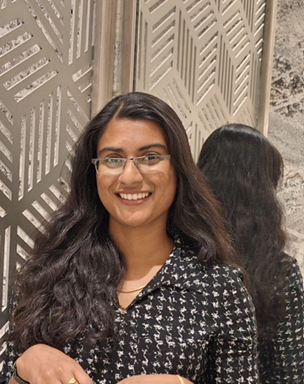
Civil Engineering Department was established in 2012 with an annual intake of 60 students. The Department now offers graduate program, B.Tech in Civil Engineering with an annual intake of 30 students and post graduate program, M.Tech in Transportation Engineering with an intake of 18 students. The department is accredited by National Board of Accreditation, New Delhi, for three years first in 2019 and reaccredited for three more years in 2022.
The department faculty is rich blend of experienced professionals from the academia and the industry. The Department is equipped with nine full-fledged Laboratories engaged in Research and Consultancy apart from regular academics. Industry specific training programmes, invited talks, workshops and industrial/site visits are organized by the Department for better employability, building confidence and for overall development of the students. The department also focus on providing job oriented training through add on courses and term projects.
Department has Center for Water Research and Education (CWRE). Environmental Engineering Laboratory under this is accredited by the Kerala State Pollution Control Board. The center imparts training on water quality management and sanitation to the schools, women groups and community on a regular basis apart from testing of water samples at concessional rates.The department also offers consultancy works in the area of material testing and designing to local self-government department and other private organizations.
Welcome to the Department of Civil Engineering at Jyothi Engineering College. As we move forward into a new academic year, I am thrilled to share my vision and enthusiasm for our department. Our primary goal is to cultivate a learning environment that not only imparts technical knowledge but also encourages innovation and ethical practice among our students.
We are committed to excellence in teaching, cutting-edge research, and meaningful community engagement. Our faculty and staff work tirelessly to support our students in their academic and professional journeys. Together, we strive to make significant contributions to the field of civil engineering and to address the challenges of our evolving world.
Best regards,
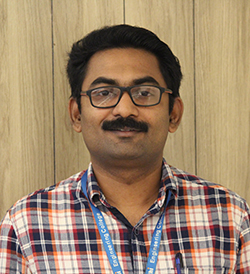
Dr. Alwyn Varghese
HoD
Department of Civil Engineering
Jyothi Engineering College
To emerge as a Centre of Excellence in Civil Engineering, nurturing ethical professionals and global leaders contributing to sustainable societal development.
1. To impart quality education in Civil Engineering through state-of-the-art technologies, industry interaction and lifelong learning to develop competent professionals.
2. To Foster integrity, empathy, professional ethics and social responsibility to develop ethical and socially committed Civil Engineering professionals and academicians. 3. To nurture research-driven, innovative, and entrepreneurial civil engineers for sustainable infrastructure and societal development. 4. To promote holistic growth, leadership, and global competence in Civil Engineering through
The program educational objectives of B.Tech in Civil Engineering are
1. Graduates will apply civil engineering knowledge, modern tools, and professional practices to plan, design, construct, and manage infrastructure projects.
2. Graduates will engage in research, innovation, higher education, entrepreneurship, and lifelong learning to address emerging challenges in civil engineering and societal development.
3. Graduates will demonstrate ethical values, leadership, teamwork, and social responsibility while contributing to sustainable and resilient communities at local and global levels.
1. Apply civil engineering principles, modern tools, and professional practices to plan, analyse, design, and execute infrastructure projects.
2. Apply theoretical concepts and technical skills in developing appropriate sustainable civil engineering solutions through self -learning, research and teamwork.
3. Integrate ethical, environmental, and societal considerations in addressing problems related to water, sanitation, soil, transportation, and urban development.
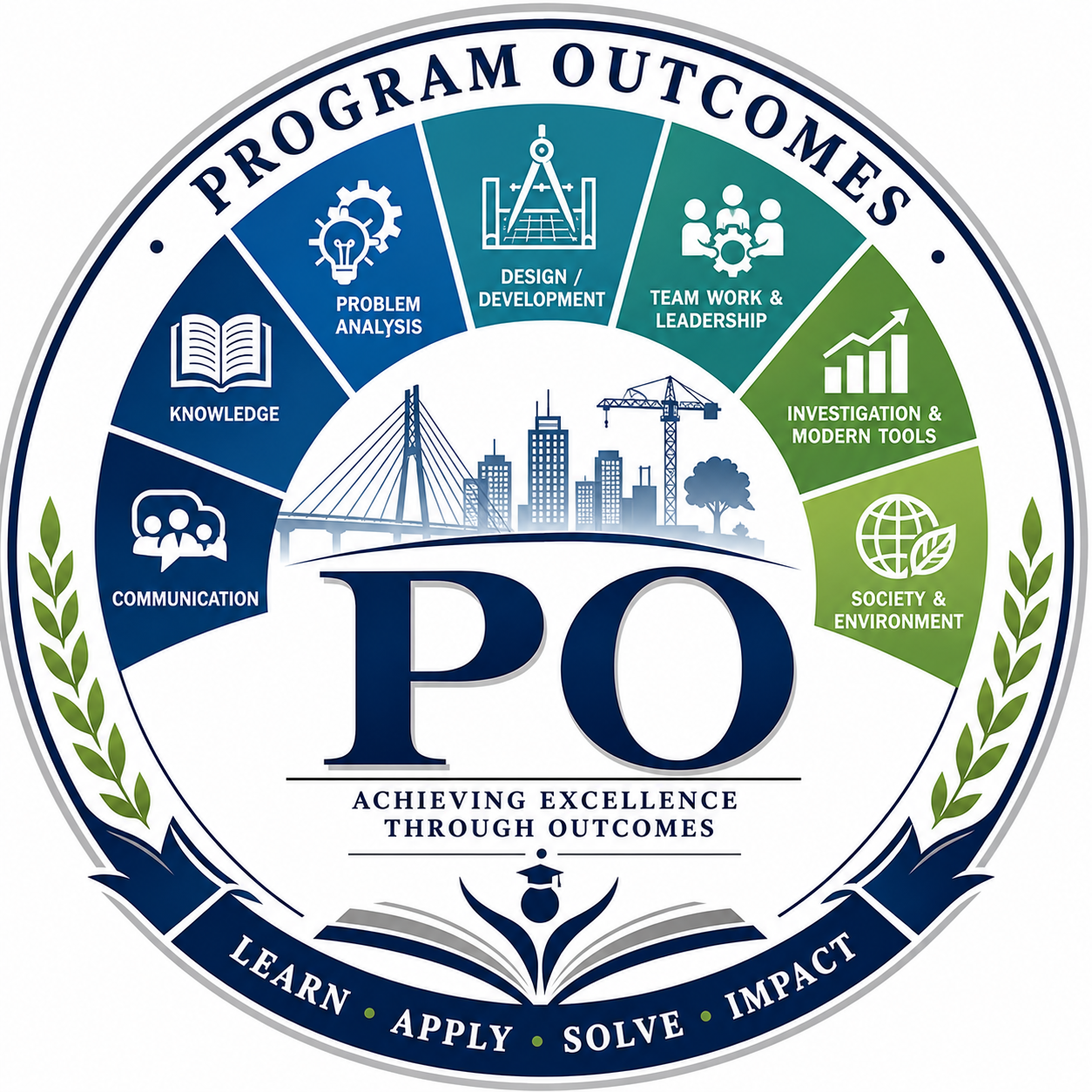
PO1: Engineering Knowledge: Apply knowledge of mathematics, natural science, computing, engineering fundamentals and an engineering specialization as specified in WK1 to WK4 respectively to develop to the solution of complex engineering problems.
PO2: Problem Analysis: Identify, formulate, review research literature and analyze complex engineering problems reaching substantiated conclusions with consideration for sustainable development. (WK1 to WK4)
PO3: Design/Development of Solutions: Design creative solutions for complex engineering problems and design/develop systems/components/processes to meet identified needs with consideration for the public health and safety, whole-life cost, net zero carbon, culture, society and environment as required. (WK5)
PO4: Conduct Investigations of Complex Problems: Conduct investigations of complex engineering problems using research-based knowledge including design of experiments, modelling, analysis & interpretation of data to provide valid conclusions. (WK8).
PO5: Engineering Tool Usage: Create, select and apply appropriate techniques, resources and modern engineering & IT tools, including prediction and modelling recognizing their limitations to solve complex engineering problems. (WK2 and WK6)
PO6: The Engineer and The World: Analyze and evaluate societal and environmental aspects while solving complex engineering problems for its impact on sustainability with reference to economy, health, safety, legal framework, culture and environment. (WK1, WK5, and WK7).
PO7: Ethics: Apply ethical principles and commit to professional ethics, human values, diversity and inclusion; adhere to national & international laws. (WK9)
PO8: Individual and Collaborative Team work: Function effectively as an individual, and as a member or leader in diverse/multi-disciplinary teams.
PO9: Communication: Communicate effectively and inclusively within the engineering community and society at large, such as being able to comprehend and write effective reports and design documentation, make effective presentations considering cultural, language, and learning differences
PO10: Project Management and Finance: Apply knowledge and understanding of engineering management principles and economic decision-making and apply these to multidisciplinary environments.
PO11: Life-Long Learning: Recognize the need for, and have the preparation and ability for i) independent and life-long learning ii) adaptability to new and emerging technologies and iii) critical thinking in the broadest context of technological change. (WK8)